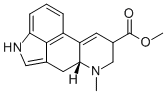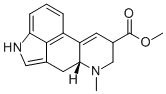
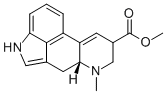
D-Lysergic Acid Methyl Ester, CAS 4579-64-0, is the methyl ester of D-lysergic acid — an ergot alkaloid derivative with the molecular formula C17H18N2O2. It is a solid at room temperature, only slightly soluble in the usual laboratory solvents, and it is held frozen because the ergoline skeleton is sensitive to heat and to repeated handling.
The compound is uncommon. It appears in the literature in two main roles: as an impurity of lysergic acid in ergot alkaloid work, and as a tryptamine-family compound whose serotonin receptor activity has been characterised in pharmacological studies. Laboratories buy it as a methyl lysergic acid reference material — to assign a peak, to challenge a method, or to see what a degradation study has produced — rather than to run it as a production reagent.
Because so much of its value sits in the identity record, each lot is tied to a defined CAS, formula, synonym set and structure identifier, and it is stored at −20 °C before dispatch. Laboratories comparing research chemicals suppliers for an ergot alkaloid reference usually settle the decision on three things: whether the identity is unambiguous, whether the storage history is intact, and whether the supplier can handle the licensing conversation. Those three decide most orders.
| Property | Value |
|---|---|
| CAS number | 4579-64-0 |
| Chemical name | D-Lysergic Acid Methyl Ester |
| Molecular formula | C17H18N2O2 |
| Molecular weight | 282.34 |
| Form | Solid |
| Colour | Pale grey to black |
| Melting point | 164-166 °C (Solv: benzene (71-43-2)) |
| Boiling point | 469.0 ± 45.0 °C (Predicted) |
| Density | 1.30 ± 0.1 g/cm³ (Predicted) |
| pKa | 17.25 ± 0.40 (Predicted) |
| Solubility | Chloroform (slightly), DMSO (slightly), methanol (slightly) |
| Storage | −20 °C freezer |
Lysergic acid methyl ester belongs to the ergot alkaloid family, and within it to the ergoline derivatives that share the fused indole–quinoline core. It is the methyl ester of D-lysergic acid: the carboxylic acid has been converted to a methyl ester, which changes polarity, retention behaviour and solubility compared with the free acid.
Its most widely recognized structural relative is lysergic acid diethylamide — the same ergoline core, with a diethylamide in place of the methyl ester. That closeness is exactly why the ester matters analytically. Two molecules this similar are not always resolved by a generic reversed-phase method, so a characterised standard of defined identity is what lets a laboratory demonstrate that the peak it reports is the peak it means.
Pharmacology literature classifies the compound as a non-selective serotonin receptor agonist, which is why it turns up in 5-HT receptor studies as a comparator. The predicted pKa of 17.25 deserves a careful reading: it describes an extremely weak acid rather than a typical carboxylic acid, because the acid function is esterified and the remaining exchangeable proton is far less acidic than a free carboxyl group would be. Anyone treating this material like a carboxylic acid in a mobile-phase or extraction step will be surprised by the result.
Lysergic acid and iso-lysergic acid are the main cleavage products formed when ergot alkaloids are hydrolysed under alkaline conditions. That reaction is the practical link between this ester and degradation work: it is the sort of transformation a stability study exists to catch, and it explains why the ester appears in impurity profiles of ergot-derived material.

The published preparation of lysergic acid methyl ester starts from isolysergic acid amide rather than from the free acid. In the literature record, the amide is suspended in anhydrous methanol, the mixture is cooled to about −50 °C, and a solution of hydrogen chloride in anhydrous methanol is added with agitation. The clear solution is then allowed to warm to room temperature and stirred overnight, during which the ester hydrochloride begins to crystallise. Cooling in an ice bath and adding ethyl acetate completes the crystallisation, and the precipitate is collected by vacuum filtration. The record reports roughly 84% of theory as the hydrochloride salt.
Two details in that description explain a great deal about how the material behaves in a buyer's hands. The first is that the whole operation depends on anhydrous conditions — water pushes the ester back toward hydrolysis, which is why the methanol and the acid are both specified as anhydrous. The second is that the product is isolated as the hydrochloride, not as the free base, so a laboratory converting between the two forms is changing the material and should record it as a conversion rather than as drying.
Our part as a fine chemicals manufacturer is to supply the methyl lysergic acid reference material with an identity record that matches the literature description. We do not provide process detail, scale-up support or route development for this material, and enquiries are handled on the basis of analytical or research use.

Ergoline derivatives of this family are regulated in many countries, and the rules are not uniform. Some jurisdictions list the methyl ester by name; others reach it through analogue provisions that capture close structural relatives of a scheduled substance; others require a precursor notification or an import authorisation before the material crosses a border. The rules also change — schedules are revised, and an entry that was clear two years ago may not be today. Confirm what applies at your end before you order.
In practice, orders are accepted for licensed laboratories, analytical facilities, forensic units and research institutions working under an appropriate permit, with the end use and the consignee stated on the record. Where an import authorisation, licence number or end-use declaration is required at destination, send it with the enquiry rather than after the order is placed; it shortens the process for everyone involved.
We do not supply individuals buying for personal use, and we do not support recreational or illicit applications. Established research chemicals suppliers apply the same standard, and it protects your compliance file as much as ours.
If you are unsure whether your institution is covered, ask your compliance officer first and then send us the reference your regulator issues. Answering that question before an order exists is far easier than unwinding one afterwards.
Quality is the foundation of how we work. As a specialized enterprise serving the chemical and pharmaceutical sectors, we apply staged in-process checks and a final inspection against the agreed specification before packing, and we retain samples for reference. If you prefer an independent check, we are glad to coordinate with the third-party inspection agency you appoint. Shipments travel with their certificate of analysis, packing list and safety data sheet; any item that falls short of specification is investigated, then replaced or credited. Our team supports buyers across Europe, the Americas, Australia and Japan.
The ester carries a methyl group on the acid function, which gives a molecular weight of 282.34 against 268.31 for the free acid. The mass difference is small, but the change in polarity means the two behave differently on a column, so a method set up on one will not necessarily resolve the other. Keep them as separate reference materials and check retention against your own standard rather than against a published figure.
Measured and computed values are labelled differently on purpose. The melting point of 164-166 °C is a measured figure, and the note (Solv: benzene (71-43-2)) records the solvent system it was determined with. The boiling point, density and pKa are computed estimates, which is why they carry the word predicted and a tolerance. Treat those three as describing behaviour rather than as acceptance criteria for a release specification.
The recorded range of pale grey to black covers the variation normally seen between lots and with handling, rather than describing one fixed shade. Material at the darker end of that range is still the same compound. What is worth reporting to us is a colour that falls outside the range, or any change in texture.
A 10 mM DMSO solution appears among the catalogue names for this material, alongside the solid form, which is what we normally handle. Tell us the concentration and the solvent your method calls for and we will confirm what can be prepared for your requirement; quoting the exact figure in your enquiry avoids any interpretation at our end.
It is extended stereo notation. The ampersand group marks a relative stereochemical relationship rather than an absolute one, and the InChI marks one centre as undefined with a question mark for the same reason. In other words, the record does not fix every stereocentre absolutely. If your method is stereospecific, tell us the specification you need before ordering so that what arrives matches what your method assumes.