Product Overview
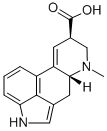
Lysergic acid, CAS 82-58-6, is the parent carboxylic acid of the ergot alkaloids and the point from which the semisynthetic ergoline derivatives are built. It is a crystalline ergoline alkaloid used in licensed laboratories as an identified reference material and the starting material for chemical synthesis intermediates across the ergoline family, not as a finished drug substance.
The acid is produced by hydrolysis of ergot alkaloids — historically from Claviceps-infected grain, today more often by submerged fermentation. That origin is worth knowing, because it explains the two things buyers notice first: the beige-to-brown colour range and the hydrate form the material takes when it is crystallised.
Published descriptions call the acid a precursor with no biological activity of its own, while pharmacological literature also records it as a potent, non-selective serotonin receptor agonist. Both statements are in circulation, and both lead to the same handling decision: treat it as a potent scheduled substance at every step.
Buyers arrive here for different reasons. An analytical laboratory needs a characterised parent peak for related-substance work. A research group wants a documented entry point into ergoline derivatives. A procurement officer needs the schedule entry, the hazard statements and the storage requirement in one place, because approval depends on all three at once.
If you are weighing one fine chemicals manufacturer against another on this compound, four things actually separate them: identity data, control documentation, hazard communication and storage discipline. Everything else can be settled later.
Specifications
| Property |
Value |
| CAS number |
82-58-6 |
| Molecular formula |
C16H16N2O2 |
| Molecular weight |
268.31 g/mol |
| Melting point |
>170 °C (dec.) |
| Optical rotation ([α]D20) |
+40° (c = 0.5, pyridine) |
| Boiling point |
411.48 °C (rough estimate) |
| Density |
1.1028 (rough estimate) |
| Vapour pressure |
0 Pa at 20 °C |
| Refractive index |
1.6240 (estimate) |
| pKa |
3.44 and 7.68 (at 25 °C) |
| Water solubility |
267 mg/L at 20 °C |
| LogP |
−0.7 at 20 °C |
| Storage |
Controlled substance, −20 °C freezer |
| HS code |
29396300 |
Chemical Definition & Naming
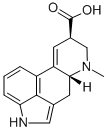
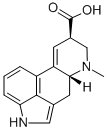
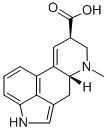
- Chemical definition. An ergoline alkaloid built on 6-methylergoline, with additional unsaturation at the 9,10-position and a carboxylic acid group at the 8-position — the definition most method documents quote.
- Systematic name. The stereodescriptors (6aR,9R) fix the configuration: (6aR,9R)-7-methyl-1,4,6a,7,8,9-hexahydroindolo[4,3-fg]quinoline-9-carboxylic acid.
- Common and catalogue names. Lysergic acid, lysergicacid, Ergoline Acid and lyserginzuur all describe the same compound; hydrated material appears in some lists as D-lysergic acid hydrate.
- Pharmacopoeial impurity names. The acid also appears in impurity listings as Ergometrine Maleate Impurity A, D-Lysergic Maleate EP Impurity A and Methylergometrine Maleate Impurity A — the names to search when your method is written against a monograph rather than a CAS number.
- Registry identifiers. MDL number MFCD00133297, FDA UNII ITO20DAO7J and CBNumber CB8261074 sit alongside the CAS number; quote whichever identifier your own system uses.
- Where it sits in the family. It is the branch point from which the other chemical synthesis intermediates and the wider semisynthetic family are made, which is exactly why it is scheduled.
- Why the naming matters. Impurity files for ergometrine and methylergometrine maleate are usually built around this parent acid, and analytical reference standards work depends on the name in the method matching the name on the batch documentation.
Appearance, Crystal Form & Reference Data
Appearance
The acid is a beige to brown powder. Colour moves a little from batch to batch — pale beige through tan to brown — and that is normal for a fermentation-derived ergoline rather than a sign of decomposition. Record what you receive against the batch record, and if a colour shift arrives together with a change in solubility or melting behaviour, hold the material and check with us before it goes into a method.
Crystal form
It crystallises from water as a hydrate, so the hydrate is the form most laboratories receive. Weigh by mass, correct for water content if your method works on an anhydrous basis, and keep the container closed between weighings; the hydrate will pick up and lose moisture with the room.
Related forms
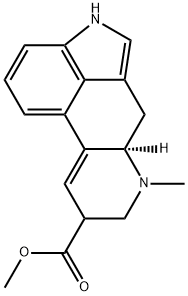
Published data also covers the neighbouring chemical synthesis intermediates: the methyl ester crystallises from benzene with a melting point of 168 °C, the amide [478-94-4] melts at 242 °C (dec) from methanol with [α]546 +15° (c 0.5, pyridine), and the (−)-hydrochloride melts at 208–210 °C (dec, from methanol). These are useful identity reference points, and they are also why a single melting point is a weak identity test here — the acid decomposes above 170 °C instead of melting cleanly.
Published record
The main preparation reference is Kornfeld et al., Journal of the American Chemical Society 78, 3087 (1956), DOI 10.1021/ja01594a039, with the earlier paper in the same journal at 76, 5256 (1954); Beilstein 25 III/IV 934 also covers the family. That literature documents the acid being obtained from its methyl ester. We cite the references so the identity file behind analytical reference standards work is complete; the procedures themselves are not part of what we supply.
Hazard Classification & Safety Statements
| Classification |
Value |
| GHS pictogram |
GHS07 (exclamation mark) |
| Signal word |
Warning |
| Hazard statements |
H302 + H332 |
| H302 — oral route |
Harmful if swallowed, acute toxicity category 4 |
| H332 — inhalation route |
Harmful if inhaled, acute toxicity category 4 |
| Routes covered by the classification |
Ingestion and inhalation; these are the two exposure routes the published statements address |
| Skin and eye statements |
Not listed in the published classification — check the batch safety data sheet before handling without gloves or eye protection |
| Flammability |
Not classified |
| Explosibility |
Not classified |
| Control rationale |
Listed as an immediate precursor in the synthesis of LSD, which is why the substance carries a schedule entry at all |
| DEA Controlled Substances code (CSCN) |
7300 |
| CSA schedule |
Schedule III |
| Narcotic schedule (NARC) |
No |
Controlled Handling Sequence
- Agree who may open the container before it arrives: a named handler, a named backup and a written procedure covering weighing, transfer and waste.
- Reserve a locked, access-controlled freezer position, with a temperature log and a secondary container so that any spill stays contained.
- Open and weigh in a fume hood or a ventilated balance enclosure. The two hazard statements that apply are driven by swallowing and by inhalation, so the enclosure exists to keep the powder out of the air.
- Dress for powder work: nitrile gloves, lab coat, safety glasses and a particulate respirator wherever dust is visible. Change gloves before you leave the balance area.
- Clear spills with damp absorbent rather than a dry brush, bag the residue, and send it out as controlled chemical waste through your licensed route.
- Record every withdrawal — date, amount, operator, remaining balance — and reconcile at month end. Controlled-substance records are the first thing an inspector asks to see.
- Brief everyone who handles the material, keep the hazard statements posted at the balance, and re-check the storage position whenever the freezer is serviced or moved.
Laboratory Applications
- Reference identity for lysergic acid. Laboratories confirm unknown ergot samples against this acid, using the CAS number, the hydrate form and the retention behaviour as the anchors.
- Impurity and related-substance files. Because the acid sits upstream of ergometrine and methylergometrine, it gives a related-substance method a characterised parent peak instead of a suspected one.
- Method development and validation. Validation work on ergoline derivatives needs material with a documented identity, and that document set decides whether a method survives review; it is also the part buyers check first when they compare research chemicals suppliers.
- Degradation studies. Studies of how ergot alkaloids break down need a characterised reference for the cleavage products, and this acid is the parent those products are measured against.
- Semisynthetic research. Groups working towards new ergot compounds use the parent acid as a characterised starting point. As a chemical synthesis intermediate it is the step regulators watch most closely, so the paperwork matters as much as the material.
- Forensic and toxicology methods. Laboratories screening for ergot alkaloids use characterised material to check retention times and confirmation transitions, and this acid is one of the reference points in that work.
Ordering & Documentation
- Tell us the pack size the batch or project needs. A quantity that covers a single validation run and a quantity that covers a longer programme are quoted separately.
- Send the licence or permit reference for the receiving site with your enquiry, along with the intended end use, so both can be reviewed before anything is confirmed.
- Ask for the documents you need — certificate of analysis, safety data sheet, batch record extract — at quoting stage rather than after dispatch. A fine chemicals manufacturer that answers that list in one reply is showing you how the rest of the supply will run.
- Agree the destination and shipping terms with our team. National controls and carrier requirements differ by country, and research chemicals suppliers cannot route scheduled material past a destination that does not permit it, so the route is confirmed per order rather than stated in advance.
- Confirm the current lead time, packing and payment terms with your sales contact. For scheduled material these move with permits and carriers, so they are set for your order rather than fixed in advance.
Batch Specification & Receiving Checks
- Fix the acceptance criterion around three fields first: the CAS number 82-58-6, the chemical name and the batch number. Whatever else the paperwork carries is read in the context of those three matching your specification sheet.
- Choose a second identity test before you write the criterion. A melting point alone is weak evidence for this acid, because it decomposes above 170 °C rather than melting cleanly; optical rotation in pyridine, an infrared comparison against a retained standard or a chromatographic retention check gives you a stronger confirmation.
- Agree the moisture basis before the first weighing. The material is isolated as the hydrate, so a result reported on the dried basis and a result reported as received are two different numbers, and mixing them is the usual reason a conforming batch appears to fail.
- Ask what the batch shipping to you can actually be documented for — identity, water content, appearance against the batch record — and set the criterion from that answer rather than from a catalogue figure. Confirm with your sales contact which tests will be reported for that batch.
- Record colour rather than reject on it. A beige to brown powder is the normal range for a fermentation-derived ergoline alkaloid, so a shade outside it is a question to raise with the batch number attached, not an automatic rejection.
- Check the outer packaging and the cold chain before the inner container is opened. This material is held in a controlled-substance freezer at −20 °C, so a shipment that has arrived warm or partly thawed is a deviation to log at once, not something to place straight into storage.
- Match label to paperwork in one pass: CAS number, chemical name, batch number, pack size and the GHS07 labelling with H302 + H332, together with the documents supplied with the shipment.
- Verify the fill quantity against the pack you ordered, then enter the receipt in your controlled-substance register the same day — date, quantity, operator, storage position — before the container goes into the freezer.
- Quarantine anything that fails a check, keep the packaging and the temperature record with it, and contact us with the batch number before the material is used or returned so the deviation can be compared against the batch record and the retained sample.
Quality Control & Inspection
Quality is the foundation of how we work. As a specialized enterprise serving the chemical and pharmaceutical sectors, we apply staged in-process checks and a final inspection against the agreed specification before packing, and we retain samples for reference. If you prefer an independent check, we are glad to coordinate with the third-party inspection agency you appoint. Shipments travel with their certificate of analysis, packing list and safety data sheet; any item that falls short of specification is investigated, then replaced or credited. Our team supports buyers across Europe, the Americas, Australia and Japan.
FAQ
Q1. What is the difference between lysergic acid and iso-lysergic acid?
They are isomers that differ at the 8-position, and published work reports both lysergic acid and iso-lysergic acid as the main cleavage products formed when ergot alkaloids are hydrolysed under alkaline conditions. The material here is the lysergic form, identified by the (6aR,9R) stereodescriptors in its systematic name. If your method has to resolve the pair, plan the separation around those two ergoline derivatives rather than assuming a single peak.
Q2. Is the acid supplied as the free acid or as a hydrate?
The isolated form is the hydrate, crystallised from water. That is what most laboratories work with, and it is why water content matters when you weigh small amounts. If your method specifies an anhydrous basis or a particular hydrate stoichiometry, tell us before the order so the specification can be checked against your requirement.
Q3. Does the US Schedule III entry apply in our own country?
The Schedule III entry is a US classification. Every country publishes its own controls, and the US entry does not travel with the shipment, so a fine chemicals manufacturer cannot settle that question for you. Check the position with your own authorities before you commit to a purchase.
Q4. What should we check when the delivery arrives?
Match the label against the CAS number, the chemical name and the batch number, and look over the outer packaging before the inner container is opened. Record what you see against the batch record, then move the material into controlled storage the same day. Most buyers working with research chemicals suppliers on scheduled compounds already have that check written into their SOP; if yours does not yet, it is worth adding.
Q5. No purity figure is published — how do we set a specification?
We confirm the specification for the batch that is shipping rather than publishing one number for everything, because identity work, related-substance work and analytical reference standards work all test the material differently. Tell us the method and the acceptance criteria you are working to, and we will confirm what can be documented on the current batch.