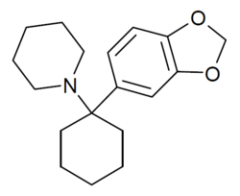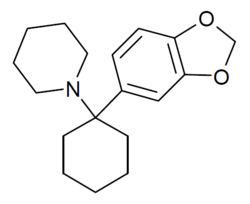
| Identifiers | |
|---|---|
| CAS Number | |
| PubChem CID | |
| ChemSpider | |
| Chemical and physical data | |
| Formula | C18H25NO2 |
| Molar mass | 287.403 g·mol−1 |
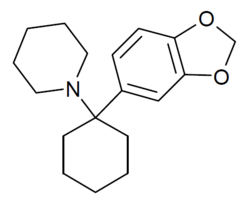
MDPCP (methylenedioxyphencyclidine, also written 3',4'-MD-PCP) is a reference material for analytical and research laboratories. The molecule keeps the phencyclidine skeleton — a phenyl ring joined to a cyclohexane ring that also carries a piperidine nitrogen — and closes a methylenedioxy bridge across two adjacent positions of the phenyl ring. That bridge is what separates it from the better-known methoxy analogues, which carry a single methoxy group at one position instead of a ring.
In practice the material is used as an identity reference. A small quantity is weighed, dissolved and diluted to the working concentration, then run alongside samples so that a peak can be matched to a known retention time or a mass transition confirmed. Laboratories keep it in a reference collection rather than in a production line, which is why the pack sizes start in the milligram range and stop well short of bulk.
We supply analytical laboratories, contract research organisations, university research groups and specialist distributors rather than private individuals. Every pack states the CAS number, molecular formula and molar mass so that identity can be checked the moment it arrives. When laboratories compare research chemicals suppliers, those identifiers and the batch documentation are usually the first things they look at, which is why they sit on the label rather than buried in a data sheet.
| CAS Number | 3034185-93-5 |
| Synonyms | Methylenedioxyphencyclidine; 3',4'-MD-PCP |
| Molecular formula | C18H25NO2 |
| Molar mass | 287.403 g/mol |
| Structural class | Arylcyclohexylamine |
| Ring system | Methylenedioxy-substituted phenyl, cyclohexyl, piperidine |
| Bridge position | 3' and 4' positions of the phenyl ring |
| Elemental composition | Carbon, hydrogen, nitrogen and oxygen only; no halogen in the structure |
| PubChem CID | 165360308 |
| ChemSpider ID | 129539440 |
| Related compounds | 3-MeO-PCP; 4-MeO-PCP |
| Intended for | In-vitro laboratory and analytical work only |
| Not intended for | Human or animal use |
The molecular formula is C18H25NO2 and the molar mass is 287.403 g/mol — one nitrogen and two oxygens on a C18 skeleton. Both oxygens sit in the methylenedioxy bridge, an O–CH2–O unit fused across two adjacent carbons of the phenyl ring, so they form a small ring of their own rather than hanging off as separate substituents.
That bridge sits on an arylcyclohexylamine core: a cyclohexane ring carrying the aryl group and the piperidine nitrogen at the same carbon. The result is a compact, rigid molecule. The aryl group cannot rotate about a methoxy oxygen, because there is no methoxy oxygen — the two ring positions are tied together instead.
For analytical work the practical consequence is that methods do not transfer between analogues. The formula carries one more carbon and one more oxygen than a single-methoxy analogue, so the accurate mass, the isotope pattern and the fragmentation all differ. Transitions and retention windows written for a methoxy compound will not identify this one; build the method around this formula rather than adapting the other one.
Two further details help when you are confirming identity. The methylenedioxy protons give a distinct two-proton signal in 1H NMR that a methoxy analogue does not show, and the nominal mass of 287 sits clear of the methoxy series in a full-scan experiment. Physical form and solubility follow the batch specification rather than the structure, so read them from the batch document before you plan a solution.
Published pharmacological work describes MDPCP as an NMDA receptor antagonist, the same receptor target reported for other compounds in the arylcyclohexylamine family, including 3-MeO-PCP and 4-MeO-PCP. That description comes from the literature rather than from testing we carry out, and it is a characterisation of the molecule — not a specification of the material in the vial.
If you are citing the compound in a report, keep the receptor target and the CAS number together so that the reference is unambiguous and cannot be confused with a methoxy analogue.
A reference material supports that work only when its identity is beyond question, because a receptor result is meaningful only if the substance studied is the substance named. That is why this pack carries its identifiers and batch reference rather than a marketing description.
What we do not publish is information on human effects, dosing or routes of administration, and we do not supply material for those purposes. This compound is offered for in-vitro laboratory and analytical work only and is not for human or animal consumption.
Laboratories that run the same method month after month want the same pack size and, where possible, the same batch, so that a calibration curve can be carried forward instead of rebuilt. Tell your sales contact how often you re-order and which pack you standardise on, and we will keep the format consistent between shipments.
Distributors building a range usually want a short, accurate list rather than a full catalogue: which compounds your customers already ask for, which identifiers they quote, and the pack sizes they expect to see on the shelf. Buyers who already carry several fine chemicals manufacturers' lines tend to check batch documentation and pack labelling first, because that is what their own customers ask them for.
Multi-site organisations can consolidate an enquiry and split the delivery by address, with one document set covering the whole order. If you maintain a controlled-substance register, ask for the batch reference and the analysis document to be issued together, so that the log entry and the shipment arrive in step.
Quantities above the standard pack range are quoted individually, and repeat orders are handled against the pack size and documentation you used last time unless you tell us otherwise.
Quality is the foundation of how we work. As a specialized enterprise serving the chemical and pharmaceutical sectors, we apply staged in-process checks and a final inspection against the agreed specification before packing, and we retain samples for reference. If you prefer an independent check, we are glad to coordinate with the third-party inspection agency you appoint. Shipments travel with their certificate of analysis, packing list and safety data sheet; any item that falls short of specification is investigated, then replaced or credited. Our team supports buyers across Europe, the Americas, Australia and Japan.
Both of those analogues carry a single methoxy group on the phenyl ring, while this compound closes a methylenedioxy ring across two adjacent positions instead. The difference shows in the formula — C18H25NO2 here, with the two oxygens tied into the bridge — and therefore in molar mass, fragmentation and retention behaviour. They are related compounds, not interchangeable ones.
Start with the CAS number and molecular formula on the label, then check the molar mass against the batch document. In the laboratory, a short 1H NMR run confirms identity through the methylenedioxy signal, and an LC-MS injection confirms retention time and the expected mass transition. Record the batch number with every result you keep.
That depends on your method and on the batch, so we do not prescribe one. Screen a small portion in the solvent your method already uses and check for complete dissolution before making up the full volume. If you need a solubility data point for a validation file, ask your sales contact and we will tell you what is available for the lot you receive.
No. A calibration standard has to match the analyte, and this compound differs from the methoxy analogues in formula, mass and fragmentation. Calibrating a 3-MeO-PCP method against it would quantify something the method was not written for. Each analogue needs its own characterised standard.
Reseal it under dry conditions, keep it away from light and hold it at the temperature stated on the label. Take a portion rather than returning unused material to the stock vial, and aliquot any solution so that the bulk is not warmed and cooled repeatedly. If your facility must store it differently from the label condition, confirm the acceptable range with us first.
It is one of our laboratory chemicals — a reference material for analytical and research work — and it is not an active pharmaceutical ingredient, a medicine, or anything intended for human or animal use. If your project needs a pharmaceutical-grade material with a pharmacopoeial specification, this is not that product, and we will tell you so before you order.