Product Overview
Methoxpropamine is an arylcyclohexylamine research compound built on a cyclohexanone ring, supplied for laboratory work as the racemate.
It reaches most laboratories as a small, characterised lot — something to run alongside a method, to check an identity against, or to hold in a compound collection — rather than as material consumed by the kilogram.
Orders come from analytical and toxicology laboratories, from R&D groups working on structure-related questions, and from distributors stocking for their own laboratory customers. Milligram packs suit method work and pilot studies; if a project needs more, ask and we will confirm what is available.
We handle the compound ourselves as a fine chemicals manufacturer, so the identity data, the batch number and the pack size on your paperwork all come from the same source.
Chemical Moieties
| Property |
Value |
| Compound name |
Methoxpropamine |
| Systematic name |
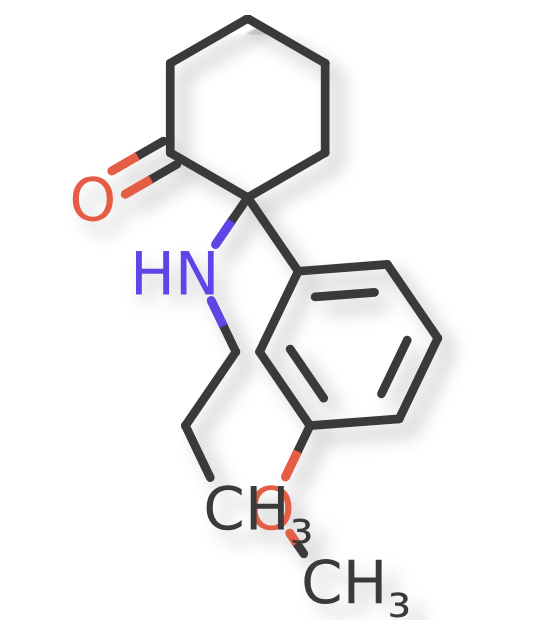
2-(3-methoxyphenyl)-2-(propylamino)cyclohexan-1-one |
| CAS number |
2504100-71-2 |
| Molecular formula |
C16H23NO2 |
| Molecular weight |
261.36 g/mol |
| Structural motif |
Phenylcyclohexyl ketone carrying a 3-methoxy aryl group |
| Stereochemistry |
Racemic |
| Optical activity |
(±) |
| Defined stereocenters |
1 |
| E/Z centers |
0 |
| Net charge |
0 |
| Additional stereochemistry |
No |
| Molar ratio |
1 |
Stereochemistry & Racemic Form
- Racemic by specification. The material is an equal mixture of the two enantiomers, so optical activity is reported as (±) rather than as a single signed rotation. If a report needs a signed value, this grade will not supply one.
- One stereogenic carbon. The cyclohexanone carbon that carries the 3-methoxyphenyl and propylamino groups is the only defined stereocenter; the structure has no E/Z centers and no additional stereochemistry. Everything that separates the two enantiomers sits at that single point.
- What a chiral method sees. Chiral HPLC, chiral SFC or a chiral shift reagent will resolve two peaks from this material; an achiral method sees one. A method transferred from an enantiopure standard needs re-checking before it is used on this lot.
- Racemate only from us. As a fine chemicals manufacturer we supply this compound as the racemate. A single-enantiomer grade is a different material and would have to be discussed as a separate requirement.
- Substitution position matters. The methoxy group sits at the 3-position of the aryl ring on the phenylcyclohexyl skeleton. Moving it to the 2- or 4-position gives an isomer with the same formula and a different CAS number, which is a common source of mix-ups when compounds are ordered by shorthand.
- Report it as racemic. In method notes and reports, describe the material as racemic (±)-methoxpropamine rather than as an (R)- or (S)-form. That keeps your data consistent with what was actually weighed out.
Laboratory & Analytical Applications
Most laboratories buy this compound from research chemicals suppliers rather than preparing it in-house, and they use it in a handful of familiar ways. In an analytical laboratory it serves as an identity check: a characterised lot run beside a sample, a retention time recorded, a spectrum compared. Toxicology and forensic groups keep it in a reference collection so an unknown can be matched rather than guessed at. R&D teams take milligram amounts to investigate structure-related questions before committing to a larger programme, and contract research groups add it to a study when a client's method calls for a racemic comparator.
In all of these settings the compound is a comparator rather than a process reagent, and that changes what matters. Identity data, pack size and a predictable re-supply count for more than bulk volume.
Storage & Handling Procedure
- Check the label before opening anything: compound name, CAS number, batch number and pack size should match the paperwork that travelled with the parcel.
- Let the container reach room temperature before opening it, so condensation does not form on the contents.
- Weigh in a ventilated area, wearing gloves, eye protection and a lab coat, on a calibrated balance; take what you need and close the container promptly.
- Seal the container tightly, protect it from light and moisture, and store it under the condition stated on the batch documentation — sensitive research compounds are normally held frozen.
- Record the date first opened and the quantity removed on the container or in your inventory, alongside the other arylcyclohexylamine and phenylcyclohexyl materials you hold.
- Clean the balance, spatula and bench after weighing, and send waste through the chemical-waste route your facility uses.
- File the batch documentation with the lot so a result can still be traced months later.
Pack Sizes & Ordering
- Pack sizes. The compound is packed in 10mg, 20mg, 50mg, 100mg, 500mg, 1g, 5g, 10g. Choose the size that matches what your method will consume; a fresh small pack is easier to keep dry than a part-used large one.
- What to send us. The compound and pack size you want, the institution and country the parcel is going to, and the end use your organisation has registered. With those details we can quote without a round of emails.
- Availability. Niche compounds move quickly — confirm current availability and lead time with your sales contact before you schedule a run.
- Terms. Payment method, currency and delivery terms are agreed with your sales contact and confirmed on the order.
- Shipping and import. Parcels are packed and labelled for laboratory receipt. Import requirements vary by destination, so check what your country asks for before ordering; clearance sits with the importer.
- Before you commit. Ask about the batch, the pack size, the documentation or the route — buyers comparing research chemicals suppliers usually want those four answers in writing first.
Compliance & End-Use Verification
- Check the status of the compound where you operate. Arylcyclohexylamine research compounds are controlled, restricted or simply unlisted depending on the jurisdiction, and that position can change.
- Confirm your organisation holds whatever licence or registration is needed to receive and hold it.
- Tell us the end use at quotation stage — laboratory research, analytical reference or distributor stock — so the paperwork matches it.
- Sign and return the end-use declaration that comes with the order; as a fine chemicals manufacturer we keep it with the batch record.
- Handle import clearance locally. Import permits, customs declarations and any domestic handling requirements sit with the buyer, not with us.
- Keep the use inside the laboratory. This compound is supplied for research work only — it is not for human or animal use, not a medicine, and not for food, cosmetic or household applications.
Quality Control & Inspection
Quality is the foundation of how we work. As a specialized enterprise serving the chemical and pharmaceutical sectors, we apply staged in-process checks and a final inspection against the agreed specification before packing, and we retain samples for reference. If you prefer an independent check, we are glad to coordinate with the third-party inspection agency you appoint. Shipments travel with their certificate of analysis, packing list and safety data sheet; any item that falls short of specification is investigated, then replaced or credited. Our team supports buyers across Europe, the Americas, Australia and Japan.
FAQ
Q1. Is the compound supplied as a free base or as a salt?
As the neutral compound. There is no counter-ion in the structure and the net charge is zero, so no hydrochloride or other salt correction is needed when you calculate a weigh-out. If a method you are transferring was written around a salt form, adjust the calculation before preparing solutions.
Q2. How do I confirm the batch matches what I ordered when it arrives?
Check the label against the paperwork before opening the container: compound name, batch number and pack size should agree, and the batch documentation should describe the same material. We keep a record for every lot we dispatch, so if anything looks wrong, photograph the label and the parcel and contact us before you open it — an identity question is far easier to settle on day one than halfway through a run.
Q3. Can it be used as a reference standard in method work?
For qualitative work — retention time, identity confirmation, a spectrum to compare against — a characterised racemic lot is usually enough. For quantitative assays, ask for the assay data that belongs to the lot and check whether your method needs a certified reference material rather than a research-grade standard. Suitability is your laboratory's call; the job of research chemicals suppliers at that point is to put the data in front of you.
Q4. How do I avoid confusing this with a similarly named arylcyclohexylamine?
Order by CAS number rather than by abbreviation. Several compounds in this family share similar shorthand, and a methoxy group in a different ring position or a different N-alkyl chain gives a compound with a different formula, a different molecular weight and a different CAS number — 2504100-71-2 for this one. Quote that number on the request and the risk of a mix-up drops sharply.