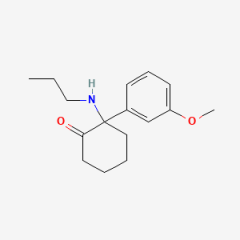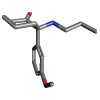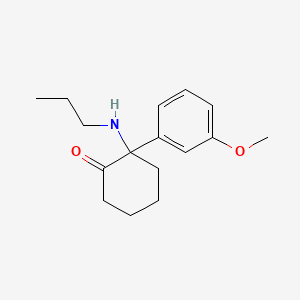
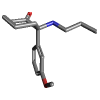


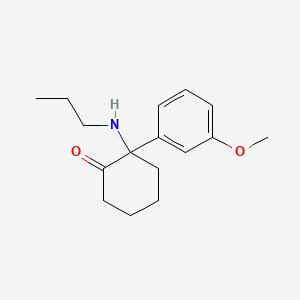
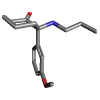
Methoxpropamine is an arylcyclohexylamine research compound built on a cyclohexan-1-one core, with a 3-methoxyphenyl group and a propylamino group on the same ring carbon. The 2D structure drawing shows that substitution pattern, and the 3D structure model gives a spatial view of the same connectivity. The compound is also listed under alternate catalog names, which are collected with the main identifiers below.
Within the research chemicals catalog, this is a structure-defined reference material rather than a formulated product. The identity data brings together the names, CAS number, formula, molecular weight and computed descriptors so that a laboratory can confirm the exact structure before a batch is quoted or a method is written around it. The material is supplied for laboratory work only.
Fine chemicals manufacturers, contract analytical laboratories and university research groups are the usual buyers. They typically need a clearly identified lot, a documented pack size and descriptor data that can be checked against an internal registration system. If your requirement is for a different salt form, a defined stereoisomer or a pack outside the standard range, confirm that with your sales contact before ordering.
The fastest way to confirm a match is to compare the CAS number, the molecular formula and the InChIKey as a set. If one of them differs from your record, stop and resolve the difference before you request a batch or release the material to a method.
| Identifier type | Recorded value |
| Product name | Methoxpropamine |
| PubChem CID | 155817932 |
| CAS number | 2504100-71-2 |
| Molecular formula | C16H23NO2 |
| Molecular weight | 261.36 g/mol |
| Synonym | 2-Oxo-3'-methoxy-pcpr |
| Synonym | LTF83AU3X8 |
| Synonym | Cyclohexanone, 2-(3-methoxyphenyl)-2-(propylamino)- |
| InChIKey | AAVOSBAXDRASAH-UHFFFAOYSA-N |
The descriptor set on this product was generated from the structure with PubChem 2.2, release 2025.04.14, using Lexichem TK 2.7.0 for the systematic name, InChI 1.07.2 for the InChI and InChIKey, and OEChem 2.3.0 for the SMILES. These are computed values, not experimental measurements, so they should be treated as identity tools rather than as assay results.
They are most useful when you are matching a database entry, writing a method SOP, or checking that a supplier's listing supports the same connectivity before you request a quote. If an internal record shows a different descriptor string, stop and resolve the difference before ordering.
InChI=1S/C16H23NO2/c1-3-11-17-16(10-5-4-9-15(16)18)13-7-6-8-14(12-13)19-2/h6-8,12,17H,3-5,9-11H2,1-2H3
The InChI string encodes the formula, connectivity and hydrogen layer for this structure. The first block, C16H23NO2, confirms the formula; the /c section carries the atom connections; the /h section lists the hydrogens. InChI is the better choice when you need a portable identifier for a database or a regulatory dossier, because it is readable and layered rather than a fixed-length hash. The string above does not define a stereochemical layer, so it should not be used on its own to distinguish stereoisomers.
SMILES: CCCNC1(CCCCC1=O)C2=CC(=CC=C2)OC
The SMILES string starts with the propylamino chain (CCCN), closes it onto a cyclohexanone ring (C1...C1=O), and attaches the 3-methoxyphenyl group (C2=CC(=CC=C2)OC) to the same ring carbon. Cheminformatics tools and many ELNs accept SMILES directly, which makes it convenient for structure search, substructure queries and building a registration record. Use it alongside the InChI and the 2D drawing rather than as a stand-alone identity check: a SMILES string describes connectivity, not purity or batch quality.
Treat this material as a laboratory research chemical and handle it under your institution's chemical hygiene plan. Work in a ventilated area with gloves, eye protection and a lab coat, and use the containment level your SOP requires for weighing and dispensing. Keep the container tightly closed, cool, dry and protected from light; the batch label and safety data sheet take precedence over general storage guidance.
Let the container equilibrate to room temperature before opening to reduce condensation, and keep the original labeled container rather than transferring the material into an unlabeled vial. Record the batch number, CAS number and opening date in your notebook and on any sub-aliquots you prepare. Dispose of waste through your licensed chemical waste stream, and do not allow the material to enter drains or the environment. If your laboratory stores research chemicals under controlled conditions, follow your internal segregation rules and keep the material separated from incompatible oxidizers and acids.
Quality is the foundation of how we work. As a specialized enterprise serving the chemical and pharmaceutical sectors, we apply staged in-process checks and a final inspection against the agreed specification before packing, and we retain samples for reference. If you prefer an independent check, we are glad to coordinate with the third-party inspection agency you appoint. Shipments travel with their certificate of analysis, packing list and safety data sheet; any item that falls short of specification is investigated, then replaced or credited. Our team supports buyers across Europe, the Americas, Australia and Japan.
The identity data provided for this product does not assign a stereochemical form; the InChI and InChIKey describe the connectivity layer as drawn. If your method requires a defined stereoisomer, confirm the exact material with your sales contact before ordering. Laboratory chemicals suppliers should also check that the catalog entry they hold uses the same CAS number and key.
No purity figure is stated for this product. Fine chemicals manufacturers and QA teams should ask for the current batch specification and certificate of analysis before setting release criteria. The certificate should list the batch number, CAS number and test method so you can compare it with your own method.
It is a laboratory reference compound for analytical method development, reference solution preparation and structure-based research where the work is licensed. It is not for human or veterinary use, and it is not a therapeutic, diagnostic or cosmetic ingredient.
They are different research chemicals with different CAS numbers, formulas and descriptor sets. 3-MeO-PCE has a different CAS number and formula. Use the CAS number and InChIKey rather than the abbreviated name when you compare supplier listings, because similar arylcyclohexylamine names are easy to confuse.
The formula and molecular weight describe the structure as drawn, with no salt form specified. If your method calls for a particular salt or hydrate, confirm the exact form with your sales contact before ordering. Research chemicals suppliers should make the same check when they list the material for their own customers.